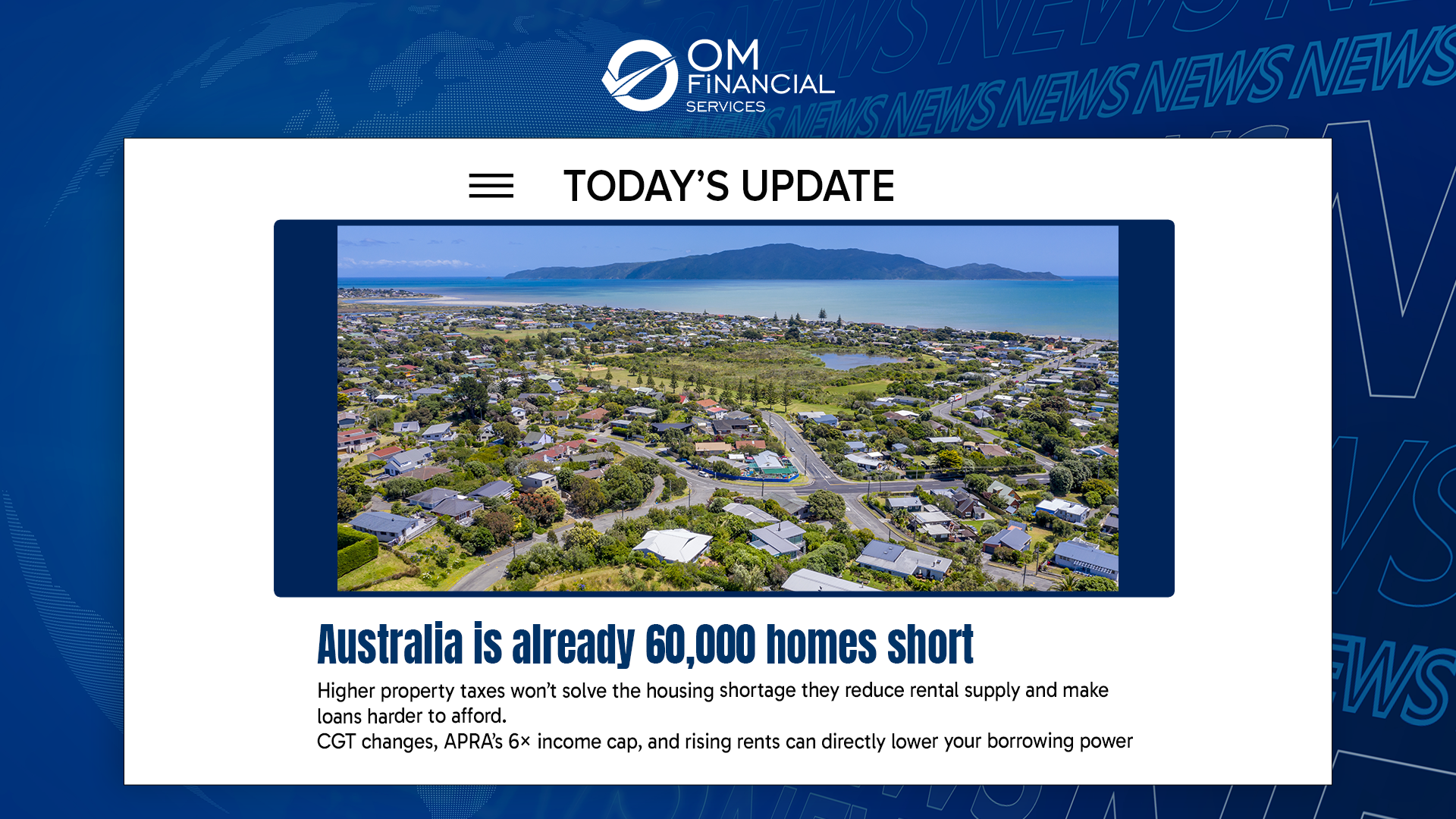
Lifting Taxes Won’t Get More Homes Built, What Borrowers Should Know
Australia’s housing supply has become an important issue for home buyers, renters and property investors. The Australia housing shortage debate focuses on how quickly new homes can be built, the cost of construction and whether policy changes will encourage or discourage investment. Industry groups warn that higher taxes on property won’t fix Australia housing shortage. Housing Industry Association (HIA) Managing Director Jocelyn Martin notes, “Housing is already one of the most highly taxed sectors” in the economy. Independent analysis shows nearly half the price of a new house-and-land package is made up of taxes, fees and charges. Those burdens are already “reducing the ability of the market to deliver new homes”.

At the same time, supply is lagging. Under the government’s 1.2 million homes target, the construction industry fell about 60,000 Australia housing shortage of the first-year mark. Builders are operating below capacity, meaning demand far outstrips new supply. HIA warns that right now we have more households seeking accommodation than there are homes available. This shortfall is a key reason home prices and rents keep rising.
Investors play a big role in this picture. About two in every five new homes were financed by property investors last year. If taxes on investment properties go up (for example, by cutting the capital gains tax discount), many investors may reconsider. HIA warns that would push investors out of the market – every investor that sells a home reduces the rental stock by one. In fact, recent surveys show over a third of landlords are already ready to sell if CGT changes proceed. That would tighten an already very tight rental market (national vacancy rates are around 1.4%). In practice it means even higher rents and yields on properties – so both renters and buyers would feel the squeeze. The experts’ bottom line: higher taxes won’t build homes, but faster building will. Legislators have a Senate review of the CGT discount underway, but HIA argues the focus should be on reducing hurdles to construction.
What borrowers and investors should do now
- Review your borrowing power and budget early. With home prices and rents still high, know exactly what you can afford. Consider getting a home loan pre-approval now. That will lock in a loan amount and show sellers you’re ready. Remember APRA’s new rules – from Feb 2026 lenders will limit loans above 6× your income. High-debt loans (common for investors) will be harder to get, so lenders will be strict on serviceability and buffers. A broker can help you check if your loan fits the new rules.
- Consider refinancing while conditions are favourable. Home values have climbed, so you might have extra equity. Refinancing now could let you secure a lower rate or switch loan type. A lower interest cost or easier terms can free up cash, which is useful if rents keep rising. We can compare dozens of lenders to see if you can save on your repayment or lock in stability. Refinancing advice can make sense even if rates haven’t moved – small savings add up over time.
- Be ready for policy changes and tax uncertainty. It’s unclear if or when CGT rules will change – the Senate committee report is expected later this year.
At OM Financials, we make the home loan process simple and guide you every step of the way. You can book a free consultation or call us anytime at 0478 876 967 to discuss your home loan needs and options. Also, don’t forget to follow us on LinkedIn and Instagram as well.
Frequently Asked Questions
What is causing Australia housing shortage?
Supply is influenced by construction costs, planning and infrastructure constraints, labour availability, land supply and the pace of new-home construction.
Will higher property taxes solve the Australia housing shortage?
Taxes alone are unlikely to address every supply constraint. Their impact depends on the policy design and its effects on development, investment and housing demand.
How can a Australia housing shortage affect renters?
When rental demand exceeds available supply, renters may face more competition and higher costs. The impact varies between local markets.